Podcasting has grown from a niche hobby into a full-blown publishing industry, and with that growth has come a serious logistical challenge: the tools. Most podcast creators today are working across four, five, sometimes six different platforms just to get a single episode out the door.
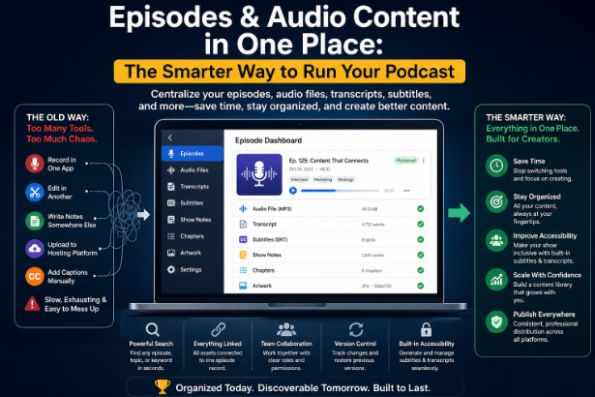
They record in one app, edit in another, write show notes somewhere else, upload to a hosting platform, and then manually add captions or subtitles through yet another service. It works, technically. But it’s slow, it’s exhausting, and it leaves a lot of room for things to fall through the cracks.
That’s why the conversation around centralized audio management has picked up so much traction. When your episodes, transcripts, metadata, and accessibility tools, including a subtitle generator, all live under the same roof, the whole production process starts to breathe. You spend less time switching tabs and more time actually making content.
Why Fragmented Tools Are Quietly Killing Your Productivity
Ask any working podcaster where their time actually goes, and the answer is rarely “recording.” It’s everything else. Finding that one audio file from three months ago. Remembering which version of a transcript was the final one. Chasing down a guest’s episode across three different folders because the naming convention changed halfway through the year.
Fragmentation costs more than time it costs creative energy. When your brain has to constantly context-switch between tools, you’re burning mental bandwidth on logistics rather than ideas. And the more episodes you produce, the worse it gets. A creator managing 10 episodes a year might handle it fine. But someone putting out weekly content across multiple shows? That patchwork system will eventually crack.
There’s also the issue of version control. When your audio file, show notes, chapter markers, and captions all live in different places and get updated at different times, you will eventually publish the wrong version of something. It happens to nearly every creator at some point, and it’s almost always a workflow problem, not a carelessness problem.
What “All in One Place” Actually Means in Practice
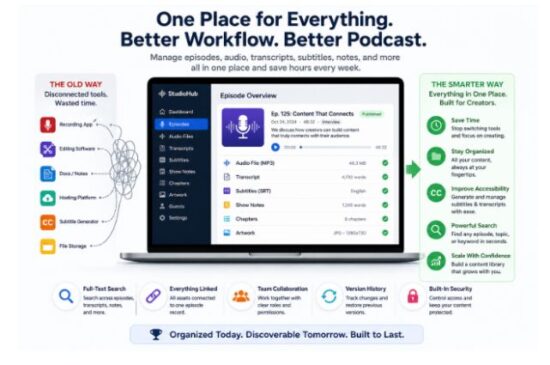
The phrase gets used loosely, so it’s worth being specific. A genuinely centralized audio content setup means that every asset tied to an episode, the raw recording, the edited file, the transcript, the episode description, the chapter markers, thumbnail images, and any subtitle or caption files, is accessible from a single interface, linked to the same episode record.
This isn’t just about storage. It’s about relationships between files. When your subtitle file is attached to the same episode as your audio file, and both are tied to your transcript, any update to one can trigger a prompt to update the others. You’re not managing assets in isolation, you’re managing a complete episode.
For teams producing podcasts collaboratively, this becomes even more important. An editor, a writer, and a show host should all be looking at the same source of truth. When they’re working out of separate folders and apps, miscommunication is almost inevitable. A unified system removes the ambiguity entirely.
his kind of structured workflow reflects how modern creators are moving toward customized solutions for streamlined performance to reduce friction and improve output consistency.
Accessibility Isn’t Optional Anymore
One area where centralized management makes an especially clear difference is accessibility. Subtitles and transcripts are no longer just nice-to-have features; they are an expectation from a growing portion of the listening and watching audience.
Deaf and hard-of-hearing listeners, non-native speakers, and people who consume audio content in environments where they can’t use headphones all rely on accurate captions and transcripts.
When those files are generated and stored separately from the episode itself, creators often treat them as an afterthought. They get uploaded late, or they don’t get updated when the audio is re-edited, or they simply don’t get made for older episodes because going back to fix them feels too daunting.
A centralized system changes the incentive structure. When subtitle generation is part of the same environment where you’re doing everything else, it stops being a separate task and becomes a natural step in the process. The barrier drops, and accessibility improves as a result.
The Search Problem Nobody Talks About
Here’s a scenario that plays out more often than most creators want to admit: someone asks you which episode covered a specific topic, or you want to repurpose a segment from an old interview, and you genuinely cannot find it quickly. You remember it was sometime last spring, it was a guest whose name started with J, and the topic was something about content distribution. Now you’re digging through folders, scrolling through your hosting platform’s episode list, and opening files one by one.
When all your audio content lives in one place with attached transcripts and show notes, this problem largely disappears. Full-text search across your entire library means you can find that episode in seconds. You type “content distribution,” and it surfaces every episode where the topic came up, whether in the audio description or the transcript itself.
For long-running shows with hundreds of episodes, this capability isn’t a luxury, it’s what makes the back catalog usable. Repurposing content, creating themed collections, or just answering a listener’s question becomes something you can do in a minute rather than a morning.
Distribution Gets Cleaner Too
One of the underappreciated benefits of keeping your content centralized is what it does for distribution. When your episode data title, description, tags, artwork, and audio file all originate from the same source, pushing to multiple platforms becomes a much cleaner operation.
Inconsistency across platforms is a common but avoidable problem. An episode title that’s slightly different on Spotify than on Apple Podcasts, a description that was updated in one place but not another, a guest name spelled differently across platforms. These are the kinds of small errors that accumulate when you’re manually managing assets in multiple systems. They don’t ruin a show, but they chip away at the sense of professionalism.
With a single source of record, you update once, and the change propagates. That’s not just a time-saver, it’s a quality control mechanism.
What to Look for When Evaluating a Centralized Platform
Not every tool that markets itself as an “all-in-one” solution delivers on the promise. There are a few specific capabilities worth checking before you commit.
Asset linking: Can you attach transcripts, captions, artwork, and show notes directly to an episode record? Or are they just loose files in the same general area?
Search depth: Does the search function reach inside transcripts and show notes, or only episode titles and descriptions?
Version history: If you re-edit an audio file or revise a transcript, can you see what changed and go back if needed?
Built-in accessibility tools: Subtitle and transcript generation that’s integrated into the same environment, not just a third-party link-out, saves significant time.
Collaboration permissions: If you work with an editor, a producer, or a virtual assistant, can you assign appropriate access levels without giving everyone the keys to everything?
The Long-Term Payoff for Serious Creators
There’s a difference between a podcaster and a podcast publisher. The distinction isn’t about ego, it’s about scale and sustainability. A publisher thinks about their back catalog as an asset. They think about discoverability across hundreds of episodes, about repurposing content into courses or books or newsletters, about handing the operation off to a team without losing institutional knowledge.
That kind of operation is only possible when your content is organized well from the start. Retrofitting structure onto years of scattered files is a painful and often incomplete process. Building it into your workflow from episode one is the move that pays dividends three years down the road.
Centralized audio management isn’t a trend it’s the natural direction for any creator who takes their show seriously. The fragmented, multi-tool approach made sense when the tools were young and the ecosystem was still figuring itself out. That time has passed. Creators who consolidate their workflows now are the ones who will have the cleanest, most searchable, most accessible, and most scalable content libraries in the years ahead.