
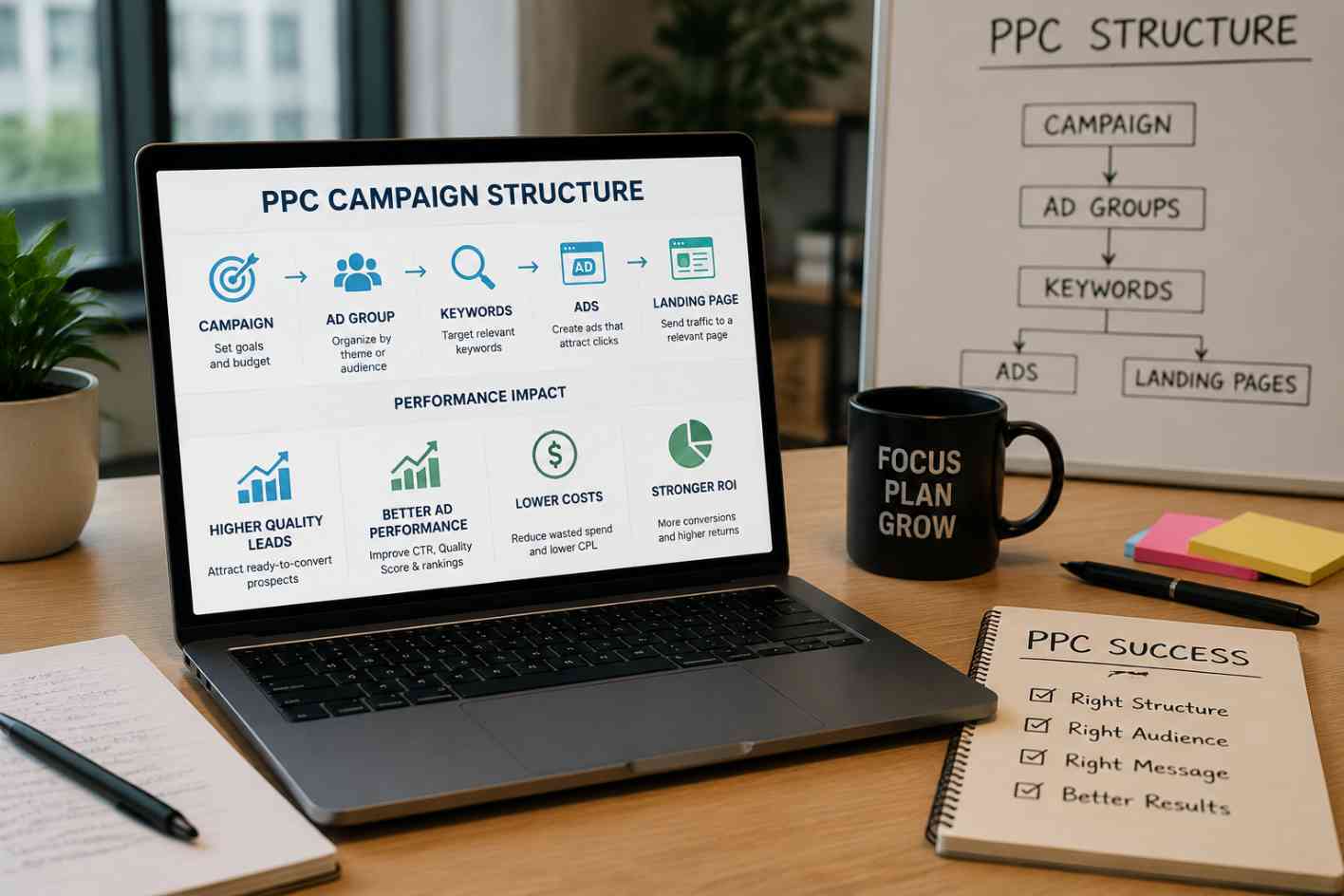
Poor PPC results are rarely caused by one dramatic mistake. More often, they come from a series of structural problems that quietly drain budget, distort reporting, and send the wrong traffic to the wrong offer. When a campaign is built without clear intent, even strong ads can underperform because the account itself is working against them.
That is why campaign structure matters so much. A well-organized account does more than keep things tidy. It shapes who sees your ads, how efficiently the budget is distributed, how accurately performance is measured, and whether sales or lead quality improves over time. In practical terms, structure is one of the biggest levers in PPC management, especially for businesses that care about lead quality rather than just lead volume.
For companies evaluating Gravitate One’s PPC services, the real value is not only in managing bids or writing ads. It is in building an account that filters out waste, reinforces the right signals, and creates a cleaner path from search query to qualified lead. That is the difference between an account that looks active and an account that actually performs.
Why Campaign Structure Determines Whether Traffic Is Valuable
A PPC account can attract clicks without attracting the right clicks. That is the core problem. If campaigns, ad groups, keywords, and landing pages are too broad or mixed together, the platform gets weak signals about what matters.
The result is usually expensive traffic, vague reporting, and conversion data that is too noisy to guide decisions.
Strong structure solves that by aligning intent with execution. It separates different products, services, audiences, and search themes so budget can be directed toward the searches most likely to convert. It also makes it easier to identify where waste is coming from.
If one campaign is built around high-intent services and another around research-stage queries, the difference in lead quality becomes visible instead of buried in aggregate numbers.
This is one reason businesses working with Gravitate One often start with a forensic account review. Before changing bids or creative, the team examines how the account is organized, where search query waste is entering, and whether the current setup is actually capable of producing meaningful leads. That first step is often more valuable than a quick optimization pass because it reveals whether the account has a structural problem, not just a performance problem.
The Hidden Cost of Mixed Intent
The biggest structural mistake is blending search intent. If one ad group contains emergency buyers, comparison shoppers, and early-stage researchers, the messaging cannot speak clearly to any of them. The ads become generic, the landing pages become broad, and the conversion rate suffers because the account is trying to serve incompatible audiences at once.
This is where lead quality begins to break down. You may still get form fills or calls, but they are less likely to be useful. Mixed intent makes it harder to qualify prospects before they enter the funnel, so the sales team ends up doing the sorting that the campaign should have done earlier.
What Strong Operators Separate Before They Spend More
Good PPC structure is not about creating the most campaigns. It is about creating proper boundaries. Separate traffic by business objective, offer, audience intent, and measurable value. That gives the account room to learn without contaminating one data set with another.
A disciplined structure usually improves performance in several ways:
- It isolates high-intent traffic from broad, exploratory traffic.
- It lets the budget flow toward profitable services or products.
- It creates cleaner ad group themes, which improves relevance.
- It supports more precise negative keyword lists.
- It makes conversion tracking easier to audit and trust.
- It helps identify which landing page is tied to which outcome.
This is especially important in Utah PPC management, where local competition can vary sharply by service category, geography, and search intent. A campaign that works for one location or one service line may waste budget if it is forced into the same bucket as everything else. The account needs room to reflect those differences.
Campaign Boundaries Should Follow Business Economics
The smartest structure mirrors how the business makes money. High-margin services deserve different treatment than low-margin ones. Lead types that close quickly should not be buried inside campaigns designed for longer sales cycles.
If you sell multiple offerings, one-product use should be evaluated separately from combined-product use so the budget reflects real business priorities instead of artificial account simplicity.
That distinction matters because not every lead has the same value. A campaign tied to a premium service should not be measured the same way as a campaign built for an entry-level inquiry. If the structure ignores that, the algorithm may favor cheaper, easier conversions that do not actually help revenue.
Search Queries Need a Controlled Environment
Search query control is another structural advantage. Without a clear account framework, irrelevant terms leak in and consume budget before anyone notices. With a cleaner structure, it is easier to apply negative keyword lists at the campaign level and prevent weak traffic from distorting performance.
This is one area where Gravitate One is especially methodical. Their process emphasizes eliminating waste early, rather than waiting for it to accumulate. That approach does not just save money. It protects the quality of the data the account uses to make future decisions.
Better Structure Improves Conversion Tracking and Quality Score Together
Campaign structure does not only affect traffic quality. It also affects measurement quality. If conversion tracking is not aligned to the account architecture, then the data can be misleading even when the campaigns appear healthy. You may see conversions coming in, but not understand which theme, audience, or offer created them.
That is why conversion tracking verification should happen alongside structural cleanup. When tracking is matched to the account layout, reporting becomes more credible. You can tell whether the campaign is generating the right kind of lead, not just any lead. This distinction is critical to smart budget decisions.
Quality Score also benefits from structure, although not in a superficial way. Relevance improves when ad groups are tightly organized around search themes and landing pages are built to match the user’s intent.
Better relevance can support more efficient delivery, but the deeper advantage is that the whole account becomes easier to optimize. The ads, keywords, and pages stop fighting each other.
Landing Pages Must Match the Promise of the Ad
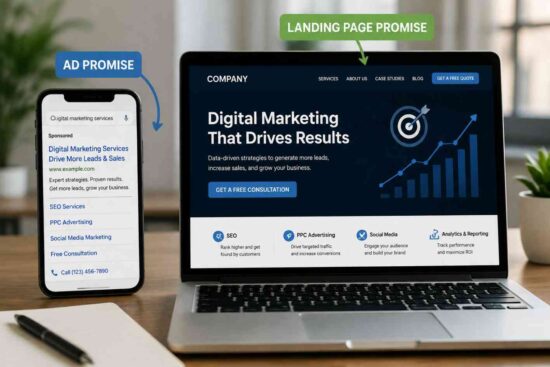
A well-structured account should not end at the click. If the landing page is too generic, the traffic loses momentum quickly. If it is too broad, it attracts unqualified inquiries. If it is too disconnected from the keyword theme, the user experience feels inconsistent, and the conversion rate usually reflects that.
Gravitate One’s approach includes landing page strategy because the page is part of the campaign structure, not an afterthought. In practice, this means the ad promise and the page content should support the same intent. When that alignment is strong, lead quality improves because the visitor understands exactly what is being offered and whether it fits their needs.
A Better Account Structure Gives You Better Decisions, Not Just Better Metrics
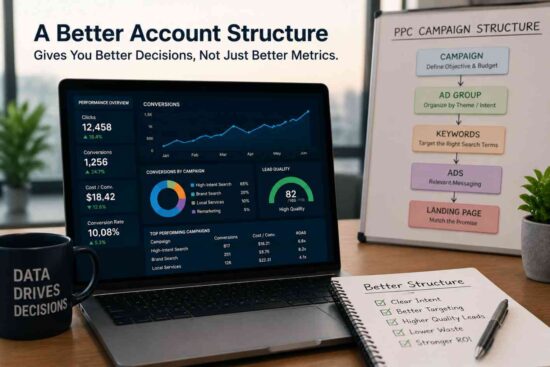
The goal of PPC is not simply to make numbers look better. This is where experienced management has a real edge. Gravitate One brings in strategists who review live dashboards, account settings, and campaign behavior directly rather than relying on generic summaries. That matters because the details inside the account often explain performance more accurately than high-level reports do.
Transparent ownership also plays a role here. Clients retain full ownership of their ad accounts and data, which keeps the relationship clean and the reporting honest. When the advertiser can see the structure, the search terms, the conversions, and the landing page outcomes, it becomes much easier to judge what is working and why.
What Good Management Changes in Practice
In a strong account, optimization becomes more deliberate and less reactive. Instead of making broad changes everywhere, management can focus on the parts of the structure that matter most:
- Split campaigns by intent or offer when the data supports it.
- Refine match types to control traffic quality.
- Adjust bids around the highest-value conversions.
- Test ads against landing pages that match each theme.
- Expand negative keyword lists to block irrelevant queries.
- Reallocate budget toward the campaigns with the best lead quality.
Those changes sound technical, but the outcome is straightforward: fewer wasted clicks, cleaner reporting, and a better chance of generating leads that are worth the follow-up.
Why Gravitate One’s Approach Fits Businesses That Need Real Lead Quality
Not every PPC provider thinks structurally. Some focus on surface-level activity, such as refreshing ads or shifting bids, without addressing the underlying account design. That may create movement in the dashboard, but it does not necessarily improve the quality of the leads.
Gravitate One is built around a different standard. Their process starts with a free strategist-led account review before any contract or monthly retainer is required. That matters because it lowers the barrier to getting an honest diagnosis. It also signals that the focus is on fit and performance, not just enrollment.
The agency’s broader positioning reinforces that same discipline. As a 2024 Netty Award winner with certified professionals across Google Ads and Meta networks, Gravitate One pairs local Utah expertise with a strong emphasis on transparency and account ownership. For businesses evaluating Utah PPC management, that combination is useful because it keeps the conversation grounded in performance, not promises.
More importantly, the structure-first approach is practical. It recognizes that lead quality is usually an account design issue before it is a creative issue. If the account is built to attract the wrong intent, no amount of ad polish will fully fix it. If the structure is sound, however, the rest of the system becomes much easier to improve.
The Long-Term Advantage Is Compounding Clarity
The best PPC accounts do not just perform better today. They become easier to manage over time. That is the hidden advantage of strong structure. Every new keyword, every test, and every budget change is more useful when the underlying account is clear.
A strong long-term strategy also benefits from a consistent approach to social platforms, making a 2026 social media playbook useful for planning and adapting campaigns throughout the year.
This is why campaign structure should be treated as a strategic asset rather than a setup task. It affects how much of your budget reaches qualified prospects, how accurately your data reflects reality, and how confidently you can scale what works. Businesses that understand this tend to make better decisions and waste less time reacting to bad data.
For teams that want more than activity, that distinction is decisive. Gravitate One’s model is built around removing waste, clarifying intent, and turning PPC into a more reliable lead-generation channel. In a market where many accounts are crowded with noise, that kind of structure is not just helpful. It is a competitive advantage.