
The demand for reliable, high-speed connectivity has never been greater for businesses. As organizations adopt more complex digital applications, from IoT devices to cloud-based platforms, the limitations of traditional, one-size-fits-all networks become apparent.
A single network trying to serve every need—from critical, low-latency tasks to routine data transfers—can lead to bottlenecks and security vulnerabilities.
What is Network Slicing?
Network slicing is a technology that allows for the creation of multiple distinct, virtual networks on top of a shared physical network infrastructure. Think of it like creating dedicated, private lanes on a public highway.
Each “slice” is an isolated, end-to-end network designed to meet the unique requirements of a particular application, service, or business unit.
This technology is a core feature of 5G networks, enabling mobile operators to move beyond a single network model and offer customized solutions.
Each slice can be configured with its own specific parameters for bandwidth, latency, security, and reliability, ensuring that critical applications receive the resources they need without being affected by other traffic on the network.
How Does It Work?
Network slicing works by virtualizing network functions and resources. Instead of relying solely on physical hardware, it uses software-defined networking (SDN) and network functions virtualization (NFV) to create and manage these independent network slices.
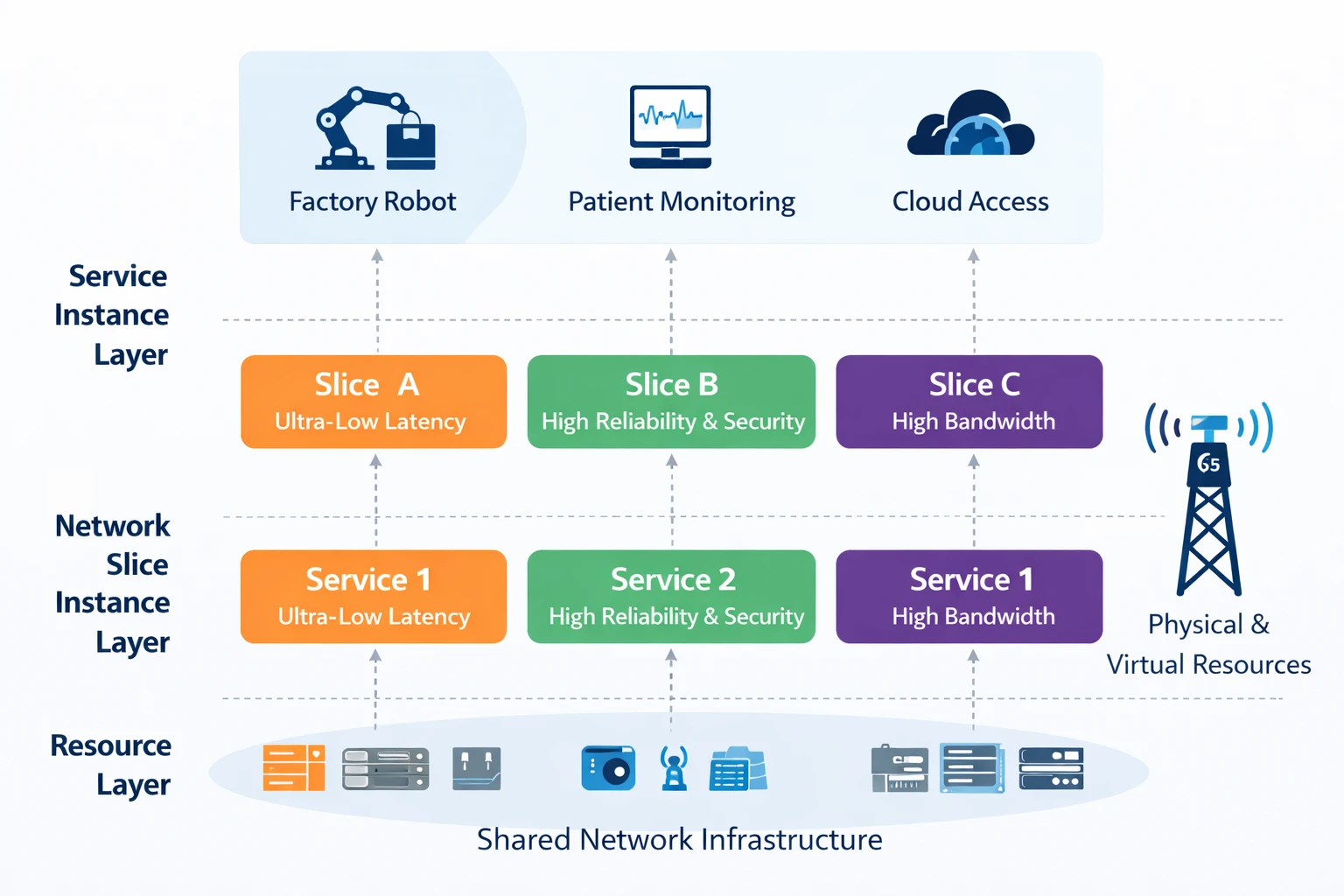
The process involves three main layers:
- Service Instance Layer: This is where the specific requirements for a service (like low latency for a factory robot) are defined.
- Network Slice Instance Layer: This layer creates a dedicated network slice based on the service requirements. It manages the lifecycle of the slice, from creation to termination.
- Resource Layer: This includes the physical and virtual resources (like computing power, storage, and bandwidth) that are allocated to each slice.
Through a central management system, network operators can dynamically allocate resources to different slices, ensuring optimal performance and efficiency across the entire infrastructure.
Key Benefits for Enterprises

For businesses, the ability to customize network resources offers significant advantages. It moves away from a one-size-fits-all approach and allows for a more strategic deployment of connectivity.
Enhanced Security
Each network slice is isolated from the others, which creates a more secure environment. If a security breach occurs in one slice, it is contained and cannot spread to other parts of the network.
This is especially important for enterprises that handle sensitive data, such as financial institutions or healthcare providers. By isolating critical applications on a dedicated slice, businesses can significantly reduce their attack surface and protect vital information.
Guaranteed Quality of Service (QoS)
Not all applications have the same performance needs. A live video stream for a remote surgery requires ultra-low latency, while sending routine emails does not. Network slicing allows businesses to guarantee a specific Quality of Service (QoS) for each application.
This means critical operations will always have the necessary bandwidth and speed, without competing for resources with less important traffic. This level of reliability is crucial for mission-critical tasks that cannot afford downtime or performance degradation.
Deep Customization and Flexibility
Every business has unique operational needs. Network slicing provides the flexibility to create networks tailored to those specific requirements. An enterprise could create one slice for its high-bandwidth data analytics, another for low-latency IoT device communication, and a third for general employee internet access.
This customization ensures that each part of the business has the ideal network conditions to operate efficiently. As business needs evolve, new slices can be created or existing ones can be modified, providing a level of agility that traditional networks cannot match.
Applications Across Industries

The practical applications of network slicing are already making an impact in various sectors, enabling innovation and improving operational efficiency.
Manufacturing
In smart factories, network slicing is essential for enabling advanced automation. A dedicated, ultra-reliable low-latency slice can support real-time communication between robots, sensors, and control systems. This ensures that automated processes run smoothly and safely.
Another slice could be used for asset tracking and inventory management, while a third supports employee communication, all on the same physical network.
Healthcare
The healthcare industry is leveraging network slicing to support a range of critical services. Remote patient monitoring, for example, requires a highly reliable and secure network slice to transmit real-time health data. For remote surgeries performed with robotic assistance, an ultra-low latency slice is non-negotiable.
This technology is also helping hospitals manage the massive amounts of data generated by medical imaging and electronic health records.
Finance
For financial institutions, security and speed are paramount. Network slicing can provide a highly secure, dedicated slice for processing sensitive financial transactions, protecting against fraud and cyberattacks. High-frequency trading firms can use an ultra-low latency slice to execute trades in milliseconds, gaining a critical competitive edge.
Challenges and Solutions
Despite its enormous potential, the widespread adoption of network slicing faces a few hurdles.
Technical Complexity
Implementing and managing multiple network slices can be complex. It requires sophisticated orchestration and automation systems to allocate resources dynamically and ensure each slice meets its performance targets. To address this, technology providers are developing advanced management platforms that simplify the creation and oversight of network slices. These platforms provide a centralized dashboard for monitoring performance and making adjustments as needed.
Regulatory and Standardization Issues
As a relatively new technology, network slicing is still navigating a landscape of evolving standards and regulations. Ensuring interoperability between different vendors and service providers is a key challenge. Industry bodies and standards organizations are actively working to create a unified framework for network slicing to ensure seamless operation across different networks and regions. The development of open APIs and standardized protocols is crucial for a thriving ecosystem of compatible edge solutions.
Conclusion
Network slicing represents a fundamental shift in how we think about connectivity. It moves us from a world of monolithic, rigid networks to one of dynamic, flexible, and service-oriented architectures. For enterprises, this technology is more than just an incremental improvement; it is a powerful enabler of digital transformation.