
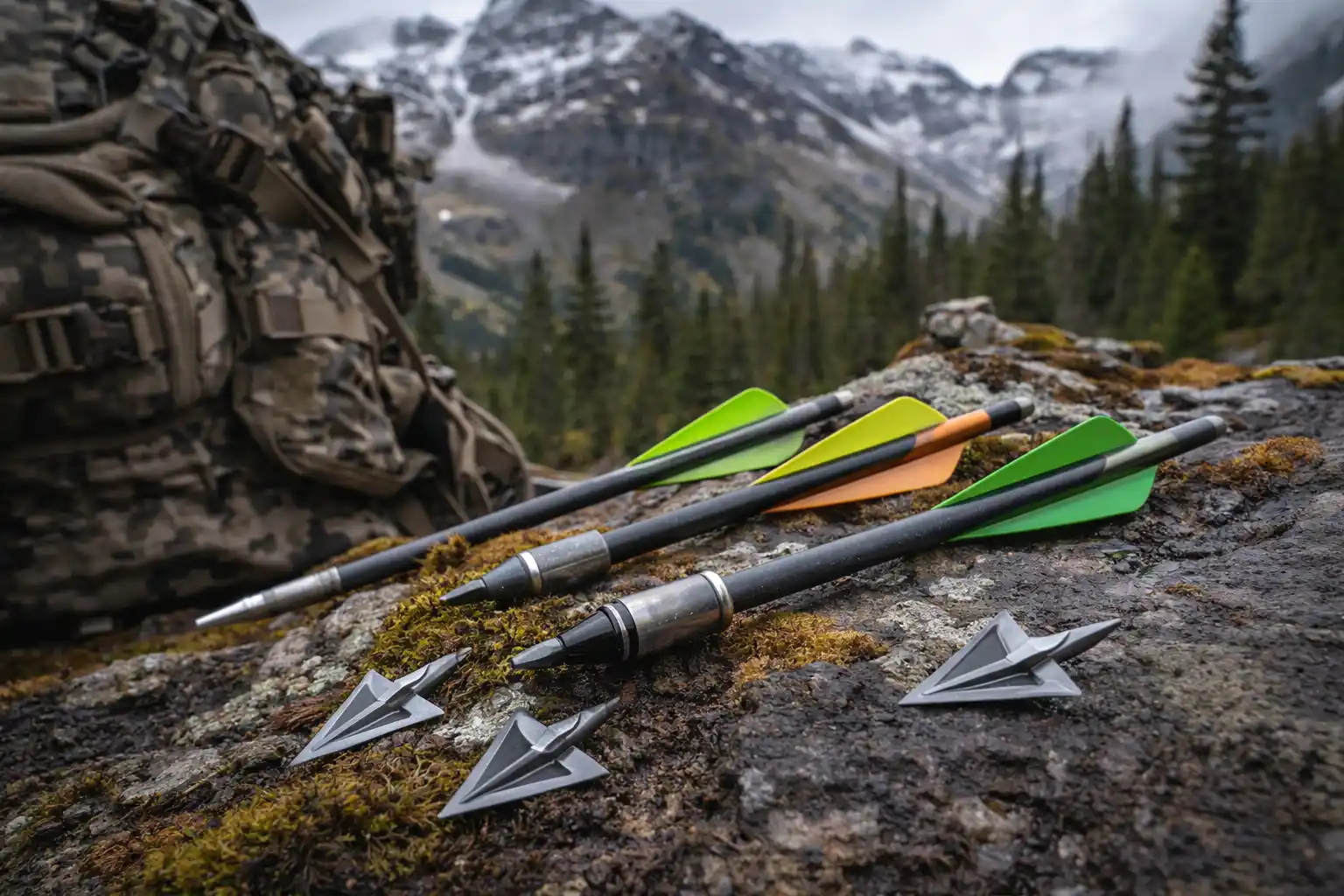
When you are miles deep in the backcountry, battling driving rain, freezing temperatures, or rugged terrain, the margin for error disappears. In these environments, the difference between a successful expedition and a critical failure often comes down to the reliability of your gear.
While many outdoor enthusiasts focus on big-ticket items like bows, packs, and boots, it is often the smaller, technical components that take the brunt of the abuse.
Failure in a small component—like a broadhead ferrule bending or a fletching peeling off in moisture—can render your primary equipment useless. To perform when it matters most, your setup requires field-tested durability. Here are four essential components designed to withstand the harshest outdoor conditions.
1. Single Bevel Broadheads with Tool Steel Blades
When hunting in rugged environments, your arrow needs to maintain structural integrity upon impact, even if it strikes bone or rocky ground. Standard stainless steel broadheads can often curl or shatter under extreme kinetic energy. This is where single bevel broadheads crafted from A2 Tool Steel stand apart.
A2 Tool Steel is heat-treated to achieve high impact resistance and edge retention. In field tests, these blades have demonstrated the ability to pass through heavy bone without suffering the edge chatter common in softer metals.
The single bevel design also induces rotation upon impact, which helps split bone rather than just cutting it, maximizing penetration. When your target is tough, your steel needs to be tougher.
- Pro Tip: Always coat your tool steel blades with a thin layer of wax or oil before heading into wet climates to prevent surface oxidation while maintaining a razor-sharp edge.
2. Hybrid Vanes for All-Weather Stability
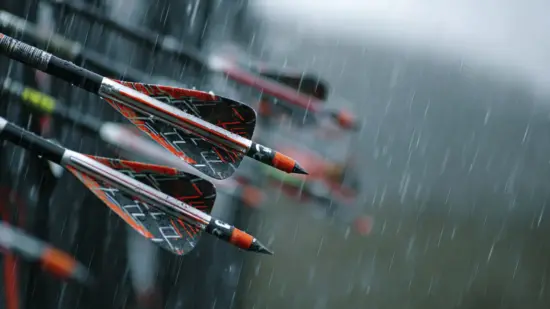
One of the most common points of failure in wet or humid conditions is arrow fletching. Traditional feathers soak up water, altering flight characteristics, while standard plastic vanes can become brittle in freezing temps or detach if the adhesive fails due to moisture. For consistent accuracy in unpredictable weather, hybrid vanes are the superior choice.
Hybrid materials combine the durability of plastic with the flexibility needed for optimal flight correction. When looking for the best arrow vanes, prioritize those that utilize a ribbed design for stiffness and a material that bonds chemically with the arrow shaft.
This ensures that even in high crosswinds or torrential downpours, the arrow stabilizes quickly and maintains its trajectory.
- Pro Tip: Use a primer pen on the base of your vanes and a high-quality cyanoacrylate glue to create a waterproof seal that won’t fail, even if your arrows are submerged.
3. Reinforced Impact Collars
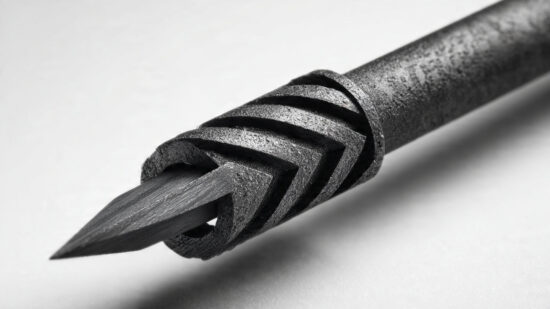
Carbon arrows are incredibly light and straight, but they are notoriously brittle at the connection points. A hard impact against a rock or a heavy bone hit can cause the front of the shaft to mushroom or splinter. To combat this, serious outdoorsmen utilize impact collars or footings.
These are metal sleeves—usually made from aluminum, stainless steel, or titanium—that slide over the front of the arrow shaft. By encasing the carbon where the insert meets the shaft, the collar acts as a shock absorber.
Data from kinetic testing suggests that sleeving the front of an arrow can increase the shaft’s durability by over 50%, ensuring that your arrow survives the shot and can be reused.
- Pro Tip: Match the material of your impact collar to your desired Front of Center (FOC) weight. Use titanium for strength without excessive weight, or stainless steel if you need to boost your arrow’s front-end mass.
4. Hidden Insert Technology (HIT)
The alignment between your broadhead and your arrow shaft is critical for accuracy. Traditional inserts that have a “lip” on the end of the arrow can sometimes be manufactured with slight tolerances that lead to wobbling. Hidden Insert Technology (HIT) solves this by sitting entirely inside the shaft.
By utilizing the interior wall of the arrow shaft for alignment, HIT inserts ensure that the broadhead spins perfectly true. Furthermore, because the threads are recessed deep into the shaft, it protects the component from bending upon impact.
This system provides a streamlined, low-drag profile that aids in penetration through tough hides and dense tissue.
- Pro Tip: Always spin-test your arrows after installing HIT inserts. If there is any wobble, you can often square the end of the arrow shaft with a sanding tool to achieve perfect alignment.
Conclusion
Navigating tough outdoor conditions requires more than just grit; it demands equipment that is engineered to perform when everything else fails. By upgrading to components that prioritize material science and structural integrity, you eliminate weak points in your setup.
Invest in gear that has been proven to handle the elements, so you can keep your focus on the pursuit rather than worrying about your equipment.