
The nose you keep noticing in selfies is roughly 30 percent wider than the one sitting on your face right now. The cause is distance. Your arm is about a foot long, and that one measurement does more damage to your face than lighting or angle ever will.
Researchers at Rutgers New Jersey Medical School and Stanford built a mathematical model of this and published it in JAMA Facial Plastic Surgery in 2018. A photo taken at 12 inches, which is about where your arm naturally holds a phone, makes the nasal base read around 30 percent wider and the nasal tip about 7 percent wider than the same face photographed from 5 feet. The Rutgers write-up is worth reading in full.
Boris Paskhover, the facial plastic surgeon who led it, kept having patients hand him selfies as proof their nose needed fixing. His description of what they were actually holding was blunt: a “portable funhouse mirror.”
The 12-Inch Problem
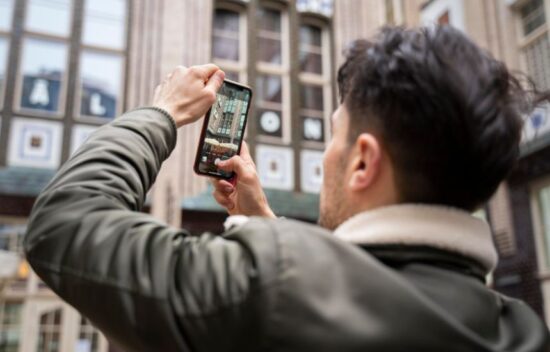
Nothing exotic is happening. It’s projection, and it’s the same math that makes the hand you stretch toward a camera look like a catcher’s mitt.
Hold your phone at 12 inches and your nose is maybe 3 or 4 inches closer to the lens than your ears are. That’s a third of the total distance. Anything a third closer to a lens is going to render bigger, so your nose and forehead push forward while your ears, jaw, and hairline fall away and shrink.
Now step the camera back to 5 feet. That same 3 or 4 inches is a rounding error against 60. The ratio collapses, the face flattens out, and what you get is close to what the person across the table from you actually sees.
Your face didn’t change between those two photos. Only one number did.
Your Phone Is Not a Portrait Lens
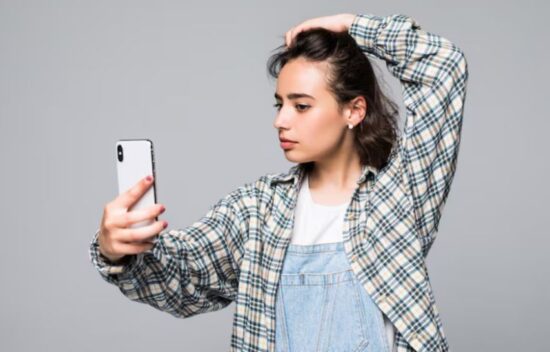
Here’s the part most explanations get wrong, including a lot of photography advice: focal length is not what distorts your face. Distance is.
The lens only decides how much of you fits in the frame from wherever you’re standing. But the two are welded together in practice, because a wide lens is what lets you fill the frame from a foot away in the first place. Your phone’s main camera sits around a 24mm to 26mm full-frame equivalent, and the front-facing camera is wider still. That’s landscape glass pointed at your face.
Portrait photographers reach for 85mm and up, and then they back up to use it. That’s the entire trick. Nothing about the lens is flattering on its own, it just forces the photographer to stand where faces look normal.
Camera Distance, Translated
| Camera distance | Lens needed to fill the frame | What your face does |
|---|---|---|
| 12 inches (arm’s length selfie) | ~24mm equivalent | Nasal base reads about 30% wider, tip about 7% wider. Jaw and ears recede |
| 2 to 3 feet (laptop webcam) | ~35mm to 50mm | Still stretched forward, softer than a selfie, wider through the midface |
| 5 feet (portrait standard) | 85mm and up | Matches what people see across a table |
If every photo you’ve judged yourself on came from the top row, you’ve been grading a version of your face that nobody in your life has ever seen.
Does Anyone Else Notice?
They do, and this is the finding that should bother you more than the nose math.
A Caltech team ran an experiment where people looked at photos of faces shot from different distances and then made decisions about them.
Faces photographed from up close, inside normal personal space, pulled lower investments in an economic trust game and lower ratings for trustworthiness, competence, and attractiveness than the exact same faces shot from farther back.
They controlled for image size, expression, and lighting, and the effect held. The full study is open access in PLOS ONE.
The part that lands: viewers had no idea why. They weren’t consciously clocking camera distance. The judgment moved anyway.
So think about where your close-range photos actually live. Your LinkedIn headshot. Your dating profile. The Slack avatar your entire company sees forty times a day. If you shot those at arm’s length because it was easier, you handed people a version of your face that quietly tests worse than the real one.
Then Video Calls Made It a Daily Habit
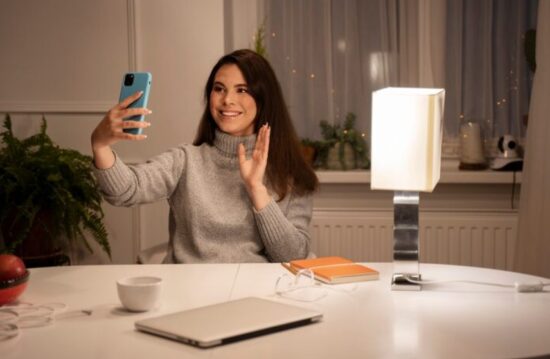
Selfies you at least choose to take. Video calls just run.
The pressure becomes even more noticeable before photo-heavy occasions, when people may scrutinize their appearance more than usual. During events such as engagement celebrations, following engagement party planning made simple can reduce last-minute stress and help create better conditions for natural, flattering photos.
A team of dermatologists led by Arianne Shadi Kourosh at Massachusetts General Hospital and Harvard Medical School surveyed board-certified providers in 2020 about what they were seeing, and named the pattern Zoom dysmorphia. Their findings ran in the International Journal of Women’s Dermatology.
Provider-reported findings from the Zoom dysmorphia survey
| Finding | Share of providers |
|---|---|
| Reported a rise in cosmetic consultations during the pandemic | 56.7% |
| Said patients cited video calls as the reason for the consult | 86.4% |
| Flagged forehead and glabellar area as a top patient concern | 80% |
| Flagged the eye area as a top patient concern | 78% |
Chart note for the editor: run this as a horizontal bar chart, four bars, 0 to 100 percent scale, title “What dermatologists reported after the shift to video calls.”
Kourosh’s point is that this is sneakier than a Snapchat filter. You know a filter is fake. Nobody told you the webcam was doing anything at all, so you file what you see under evidence.
And this did not expire with the pandemic. WFH Research, the long-running survey run by economists at Stanford, ITAM, and Hoover, puts work from home at roughly a quarter of all paid US workdays as of 2025, still several times the 2019 rate. Which means a huge number of people are still spending several hours a day watching a distorted image of themselves react in real time.
Nobody in history has had that view of their own face. Mirrors don’t talk back at you for six hours.
The Two-Photo Test
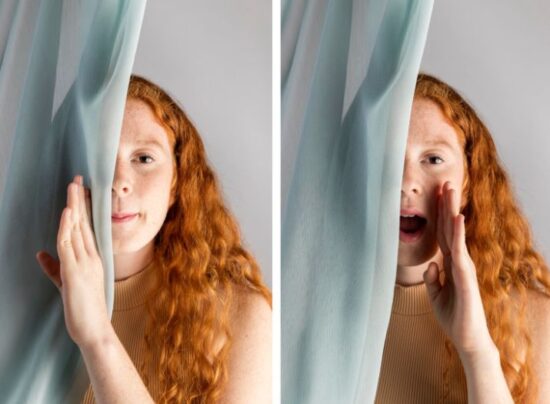
You can settle this yourself in about three minutes. Do it in one sitting so the light and your face are the same in both shots.
- Shot one. Front camera, arm’s length, however you normally take a selfie. No filters, no beauty mode, no portrait mode.
- Shot two. Prop the phone at eye level, 5 to 6 feet away. Switch to the rear camera and zoom to 2x or 3x so your head fills about the same portion of the frame. Set a 10 second timer. Same expression as shot one.
- Compare them side by side on a real screen, not a phone thumbnail.
Whatever changed between those two images is optics. Whatever survives both is your actual face.
Most people are surprised by the nose and the forehead. Some are surprised by how much narrower their jaw looked in the selfie. A few look at both and see the same thing twice, which is useful information too.
Fix the Setup Before You Fix the Face
Cheap changes, in rough order of how much they do.
- Raise the camera to eye level. A laptop on a stack of books fixes more chins than anything you can buy. Shooting up from your desk adds jaw, neck, and nostril.
- Sit back. Two to three feet from the screen instead of leaning into it. The lean is where most of the damage happens.
- Light from in front of you, not above. Overhead light drops shadow straight into your eye sockets and the creases beside your nose. A lamp or a window facing you erases both.
- Turn off self-view if your platform allows it. The researchers who named Zoom dysmorphia recommend exactly this, and it’s the single change people report the biggest relief from.
- Use the rear camera and a timer for anything that matters. Profile photos, headshots, anything a stranger will judge you on.
When It Actually Is Your Face
Here’s where the honest line sits, because the camera explanation can be pushed too far.
Facial volume does change. Collagen production slows with age, sun exposure accelerates it, and weight loss shows up in the face before almost anywhere else.
Still, appearance is not only about correcting perceived flaws. Experiences that encourage people to see themselves from a more confident perspective can also reshape self-image, which helps explain why boudoir photography inspires modern women to appreciate their bodies without relying on distorted selfies or unflattering video-call frames.
That’s not a lens artifact, and pretending it is doesn’t help anyone. Injectable treatments are also thoroughly mainstream at this point. The American Society of Plastic Surgeons counted more than 5.3 million hyaluronic acid filler procedures in the US in 2024 alone.
Clinics that handle Dermal Fillers Salt Lake City appointments see the confusion constantly: someone walks in with a screenshot from a Tuesday afternoon call and a very specific complaint about their midface.
A provider worth your money will look at you in person, at conversational distance, in normal light, and tell you which half of that screenshot was the webcam. Sometimes the answer is a treatment. Sometimes the answer is a forty dollar lamp.
One more thing worth saying plainly. If you’ve fixed the camera, run the test, and the feeling still won’t let go, if it’s eating hours of your day or steering decisions you wouldn’t otherwise make, that’s worth talking through with a professional who handles exactly that, and it’s a conversation worth having before any appointment about your face.
Take the Two Photos First
The research is unusually clear for this kind of question. Close-range photos widen your nose measurably, shift how strangers score you without their knowledge, and video calls turned an occasional distortion into a daily one that most people never got warned about.
You’re still allowed to dislike your face. Just make sure you’re looking at the right one when you decide.
So take the two photos. Put them side by side. Then ask yourself which face you were actually planning to change.