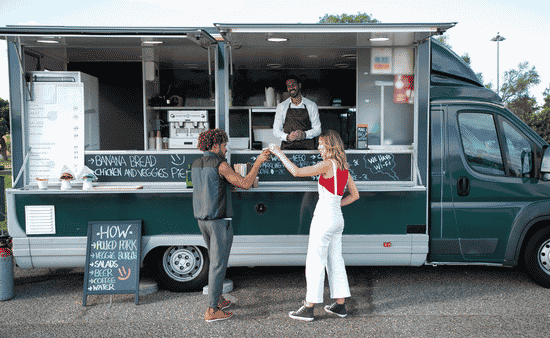
The mobile food industry has grown tremendously over the past decade, evolving into a highly competitive market driven by entrepreneurs looking for efficient, scalable business strategies. While traditional food trucks have long been the default choice, many operators are shifting toward mobile food trailers as a smarter alternative.
Modern food trailers offer a distinct structural advantage: by detaching the kitchen from the vehicle’s engine and cab, they unlock a massive amount of usable workspace.
Why Mobile Food Trailers Are Becoming a Preferred Choice
This is typically a problem in a normal food truck where staff squeeze in a tight spot causing huge production jams at rush hours. A lack of storage and prep room directly hurts efficiency when demand is highest—ultimately capping a vendor’s hourly revenue potential. By investing in spacious cruising kitchens trailers, operators can eliminate these spatial constraints, giving their team the room required to maximize peak-hour output.
Mobile food trailers solve this problem. As they don’t have any limitation in terms of the truck chassis and wheel base, the high-end mobile kitchens maximize the use of their available space for preparing food.
The extra space enables them to put in large kitchen appliances and not restrict the movement of the workers. Food trailers are best suited to serve during the weekend days, music festivals, and large catering arrangements.
More Space Means Higher Productivity
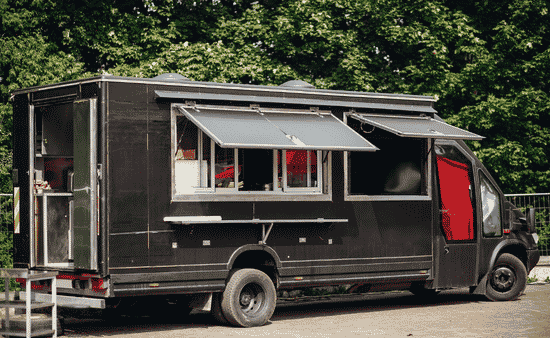
The primary structural benefit of a double-axle food trailer is the expanded floor plan. Without an engine and driving cab occupying the front third of the vehicle, the interior layout can be completely optimized for workflow efficiency.
The extra space allows team members to work like an assembly line. The staff will not get in each other’s way when they try to access materials and the stations can be arranged in a rational manner. Additionally, trailers allow placing industrial equipment that would otherwise not fit in regular food trucks, such as warmers and additional counters.
Space & Capability Comparison
| Feature | Standard Food Truck | Premium Food Trailer |
| Interior Width | 7–7.5 ft | 8.2–8.5 ft |
| Kitchen Space | ~112 sq. ft. | ~170 sq. ft. |
| Storage Volume | ~180 cu. ft. | ~310 cu. ft. |
| Equipment Capacity | 4,000–5,500 lbs | 7,000–10,000 lbs |
| Engine Dependency | Yes | No |
| Downtime Risk | High | Minimal |
Lower Costs Through Engine-Free Design
Selecting a food trailer alters the financial risk equation of a food truck. A food truck bears significant mechanical risks; malfunctioning could stop the whole food truck operation instantly. When a food truck breaks down, the entire kitchen goes to the mechanic—resulting in costly downtime and zero revenue .
Removing an engine from your food trailer solves this problem. In case of your tow vehicle breaking down on the road, you can easily attach your trailer to a rental vehicle or a friend’s pickup truck and still make it to your event location. Getting rid of an automobile also helps in reducing your insurance costs and saves you from the cost of regularly maintaining a diesel truck.
Faster Service Through Better Kitchen Layouts
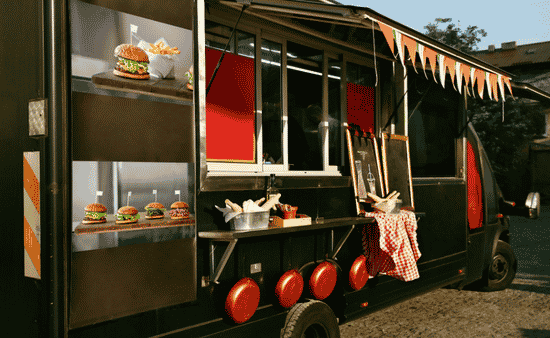
Kitchen efficiency directly dictates customer satisfaction and ticket times. Mobile trailers feature wide, linear floor designs that support an optimal workflow. Instead of pivoting around tight corners, employees can remain stationed in designated zones for prep, cooking, plating, and expediting.
This logical operational flow keeps ticket times low, even during chaotic rush hours. Those are the efficiencies that allow the group to process many more orders in an hour than it otherwise could.
Better Working Conditions for Employees
Staff turnover is a notorious problem in the food services industry, which is mostly due to extreme kitchen temperatures, lack of space, and exhaustion. The switch to a larger food trailer will automatically improve their conditions.
Key Operational Point: Due to more wall and overhead space in the trailer, it is possible to install heavy-duty ventilation equipment and have larger aisles. The improved comfort and safety conditions of the kitchen will lead to better retention of staff members.
Planning an Effective Trailer Layout
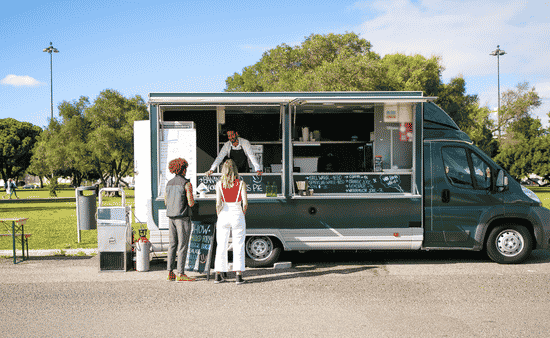
To get the most out of a mobile trailer, the interior layout must be approached strategically. When customizing a mobile kitchen, keep these blueprint fundamentals in mind:
- Weight Distribution: Place heavy machinery, such as commercial ranges and refrigeration units, directly over or near the axles to ensure safe towing and highway stability.
- Vertical Space Management: Maximize wall space with floor-to-ceiling shelving and magnetic tool strips to keep countertops entirely clear for food prep.
- Pathway Clearance: Ensure the central aisle leaves enough clearance for staff members to easily pass one another without disrupting the workflow.
A Balanced Perspective: Weighing the Trade-offs
While the benefits are substantial, a successful operation requires looking at the practical trade-offs. A food trailer needs a suitable tow vehicle, and handling the tow vehicle and the trailer takes some practice. Furthermore, setup and dismantling take a bit more time.
Nevertheless, when considering business organizations that target places that require high volume, the huge increase in kitchen capacity and lack of mechanical breakdowns greatly outweigh these logistical problems. Much like evaluating fixed vs. variable rates when making long-term financial decisions, choosing a mobile food trailer requires weighing upfront investments against ongoing operational savings and efficiency gains.
How to Transition from a Food Truck to a Trailer
In case you are thinking of taking the leap, first, audit the existing menu and operation process. Determine the machines that cause congestion in the truck, and create a trailer design that allows for a linear and assembly line process. Moreover, ensure that the tow vehicle you have is able to tow the double-axle trailer full of the commercial machinery.
Final Thoughts
A high-capacity trailer is an excellent choice when mobile catering businesses seek to grow their businesses because it offers a good combination of increased space, reduced maintenance cost, and great operational flexibility in the future. Although all business models are different, it makes a lot of sense to go for a high-capacity trailer, such as cruising kitchens trailers, and enjoy great results from it.