
The rapid expansion of pickleball has transformed neighborhood parks and recreational centers into bustling hubs of athletic activity. Combining elements of tennis, badminton, and table tennis, this sport has attracted millions of participants due to its accessibility, social nature, and relatively gentle learning curve.
Engaging in this pastime requires very little initial investment or prior athletic experience. This comprehensive guide outlines the foundational components, essential regulations, and baseline strategies necessary to transition smoothly onto the court.
Crucial Gear for New Players
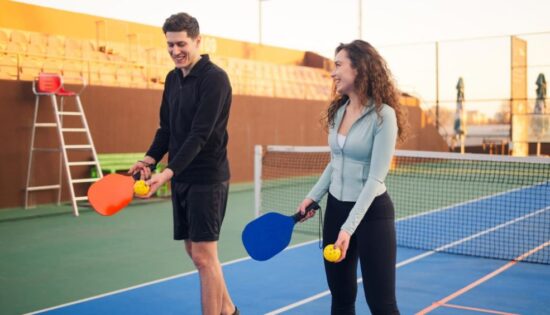
Entering the sport requires minimal equipment. The two primary items necessary for gameplay are a paddle and the correct type of ball.
Paddles are solid, lacking the strings found in tennis or badminton rackets. Modern options typically feature faces constructed from lightweight materials such as composite fiberglass or graphite, surrounding a polymer honeycomb core.
Beginners should prioritize a mid-weight option, usually weighing between seven and eight ounces. This weight range provides an optimal balance of control and power without putting excessive strain on the shoulder or wrist muscles.
The ball resembles a traditional wiffle ball, constructed from durable plastic with drilled holes distributed across the surface to minimize wind interference.
These spheres are separated into indoor and outdoor varieties. Indoor variants usually feature twenty-six larger holes and softer plastic, which yields a higher bounce on hardwood surfaces.
Outdoor options have forty smaller holes and a heavier, stiffer design to resist wind drift and withstand abrasive asphalt surfaces.
Footwear is another vital safety consideration. Running shoes lack the lateral stability required for the constant side-to-side changes of direction inherent in the sport. Opting for proper court shoes ensures appropriate traction, lowers the risk of rolled ankles, and helps prevent scuffs on the playing surface.
Understanding Court Layout and Spatial Boundaries
A standard pickleball court measures twenty feet wide by forty-four feet long, accommodating both singles and doubles formats within the exact same boundaries. The net stands thirty-six inches high at the sidelines and dips slightly to thirty-four inches at the absolute center.
The most unique and critical feature of the court is the non-volley zone, widely referred to as the kitchen. This rectangular area extends seven feet out from the net on both sides and spans the entire width of the playing space.
Players are prohibited from striking the ball out of the air while standing inside this space or touching the boundary line. To hit a ball from inside the kitchen, the ball must bounce on the ground first.
Beyond the non-volley zone lies the transition area, leading to the right and left service courts. Each service court measures ten feet wide by fifteen feet deep, ending at the baseline. Understanding these spatial boundaries prevents frequent foot faults and helps players maintain proper tactical positioning.
Fundamental Rules and Scoring Procedures

Matches are typically played to eleven points, and a team must win by a margin of at least two points. Points can only be scored by the side currently serving the ball.
Every point initiates with an underhand serve executed from behind the baseline. The server must strike the ball below the waist, utilizing an upward arm arc, and target the diagonally opposite service court. The serve must entirely clear the kitchen line to be considered valid; landing on the kitchen line results in a fault.
The flow of gameplay relies heavily on the two-bounce rule. Following the serve, the receiving team must let the ball bounce once before returning it across the net. Subsequently, the serving team must also allow the returned ball to bounce once before striking it.
Once these initial two bounces have occurred, both teams are free to either volley the ball out of the air or play it after a single bounce. This rule eliminates the advantage of a powerful serve-and-volley rush, ensuring longer, more strategic rallies.
Effective Strategies for Your First Match
Success on the court stems from patience and positioning rather than brute strength.
Beginners can learn a lot by studying what makes the best pickleball pros so unstoppable, especially how advanced players use control, placement, patience, and smart court positioning to win points.
The ultimate goal in most rallies is to safely move forward and establish a presence at the kitchen line. This forward position limits the angles available to opponents and allows for more aggressive downward angles on returns.
When stationed at the net, the most critical shot to master is the dink. This soft, controlled shot drops directly into the opponent’s kitchen, forcing them to hit upward and limiting their ability to execute a powerful smash.
Maintaining a loose grip on the paddle handle enhances control during these delicate exchanges.
Practicing consistency over power minimizes unforced errors, which account for the vast majority of lost points in amateur play. Aspiring competitors often hone their consistency locally before traveling to regional events, such as a major Orlando pickleball tournament, to witness high-level strategic play firsthand.
Etiquette and Cultural Standards
The welcoming atmosphere surrounding the sport is deeply rooted in mutual respect and clear communication.
Beginners who want to understand why the game has become so popular can explore the rise of pickleball why everyone is jumping on the court and see how its friendly culture, easy rules, and social appeal helped it grow so quickly.
Before initiating a serve, the server must audibly call out the current score so all participants can hear.
In doubles play, the score consists of three numbers: the server’s score, the receiver’s score, and whether the server is the first or second partner in the rotation.
Players are responsible for making line calls on their respective sides of the net. If a ball lands partially on a line, it is deemed in bounds.
Any uncertainty regarding a call should prompt a replay of the point or result in the benefit of the doubt going to the opposing team. Maintaining these standards ensures that matches remain fair, competitive, and highly enjoyable for everyone involved.